
Traffic Warrants in Minnesota
para
A Minnesota traffic warrant is court process inside a traffic case. It is not a driver-status record. A citation usually brings a court date or a payment deadline. Miss a required appearance and the case can move forward, but a judge decides whether a warrant issues. An unpaid payable citation, standing alone, does not prove an arrest warrant exists. A city-issued traffic or ordinance citation in Minnesota is handled in District Court; the state has no separate municipal or justice-of-the-peace court tier. The citation and any warrant stay tied to the District Court case in the filing county.
para
Court Administration can identify the case, explain the current order, and say what the judge needs next. The Sheriff's Office or jail handles service, surrender, and bond logistics. Minnesota DPS separately manages driver-license status after certain court reports. Keeping those channels straight helps a person check a Minnesota traffic warrant without mistaking a license notice or a payment page for a warrant record.
Minnesota Has No Public Traffic Warrant Portal
Minnesota has no public statewide name search for active warrants and no public traffic failure-to-appear portal. There is no statewide pay-or-lift service either. The warrant-file access required by Minnesota Statutes section 299C.115 serves authorized criminal-justice network users only. It does not open the BCA warrant file to the public or create a license-hold search.
Key point: Minnesota Court Records Online shows public case information where available. It is not a complete active-warrant index, and DPS/DVS license services do not confirm whether a court warrant is active.
A Minnesota traffic warrant question starts with the court case, and the county that issued it gives the final word. There is no public portal for this. A records request to the BCA or a county agency under the Minnesota Government Data Practices Act can still run into confidential-data rules, so a warrant lookup is not what you get back. The BCA’s public government data request form asks for a data description and a time period, nothing more. Filing it does not compel disclosure of anything classified as nonpublic. Treat it as a records channel, not a warrant check.
Statewide FTA and License-Hold Systems
Minnesota keeps court records, criminal-justice records, and driver-license records in separate systems. None of them is a public statewide traffic-warrant lookup. State law lets a court report a traffic failure to appear to DPS, but that report tracks a possible licensing consequence. It says nothing about whether an arrest warrant exists or has been recalled. For warrant confirmation on a specific case, MCRO is the public case-record route, and the issuing District Court and county Sheriff’s Office give the real answer.
| System | What It Holds | Run By |
|---|---|---|
| BCA warrant-file access | Outstanding adult and juvenile felony, gross-misdemeanor, and misdemeanor warrant data is accessible to authorized criminal-justice network users under statute; there is no public search form. | BCA and authorized criminal-justice users |
| MCRO | Public District Court case data and a warrant flag or Warrants section when available; not a full active-warrant index. | Minnesota Judicial Branch |
| DPS/DVS license status | Driver-license notices and status after statutory court reporting; not a court-warrant lookup. | Minnesota Department of Public Safety |
| Court Payment Center | Payable citation balance and payment-plan eligibility; payment does not confirm warrant recall. | Minnesota Judicial Branch and filing court |
Read each Minnesota system for what it actually does. A BCA network query is restricted. MCRO results can be incomplete. A DPS record describes license status. Only the issuing District Court can confirm its current warrant order. Note: With no public FTA portal in Minnesota, the county court and Sheriff’s Office remain the route for a confirmed warrant.
Minnesota Traffic Warrant and FTA Notice
Minnesota Statutes section 169.92 has a court report a failure to appear on a traffic citation to the Commissioner of Public Safety. Then section 171.16, subdivision 3a governs the DPS notice, which generally allows 30 days to show an appearance or payment before a possible suspension, within statutory limits. That clock is a driver-license process. It is not an arrest-warrant timer, and it opens no public search window. Minnesota law also blocks suspension based only on nonpayment of a covered traffic fine under section 171.16, subdivision 3, except for the statutory nonresident-compact case, and FTA suspension is barred for a petty-misdemeanor citation and certain specified violations. If a notice arrives, follow its instructions and ask the court how compliance is recorded. A court appearance or payment may resolve the citation itself. Still, it does not by itself establish that a separate warrant was recalled. Note: Minnesota’s FTA notice sequence tracks court compliance and possible license action; it does not certify whether an arrest warrant was issued or withdrawn.
How to Check for a Minnesota Traffic Warrant
Start with the citation or court file to find the Minnesota District Court case. MCRO’s Citation Number tab takes a ticket number, while a name search can omit some pending criminal, traffic, or petty-misdemeanor matters. The Court Payment Center shows whether a payable citation is ready for payment, but warrant status is not what it confirms. For a real answer, call the filing county’s Court Administration. If a warrant is confirmed there, the Sheriff’s Office is the next contact.
- Search MCRO by citation number or court file number and read the case’s Warrants section and event history.
- Use the Court Payment Center for a payable balance or payment-plan eligibility, not as proof that a warrant is recalled.
- Use the Minnesota county directory to reach the filing county’s Court Administration and Sheriff’s Office.
- Ask whether a judge must act, whether a hearing is needed, and how to confirm any required appearance or payment.
- Check DPS/DVS separately if a state license notice or suspension is involved.
Minnesota has no single city-court clerk to call. A city may issue the citation, but District Court keeps the case and any warrant. The ticket, county, or court file points to the right venue.
Minnesota Traffic Warrants and Citation Payment
Give a new Minnesota citation about seven days to reach the Court Payment Center system. The Judicial Branch lays out every route on its Pay a Fine instructions page. Pay online, use the automated phone lines at 651-281-3219 or 800-657-3611, or mail a check or money order to P.O. Box 898, Willmar, MN 56201. Cash never goes through the mail. You will need the citation or case number, whichever method you pick. In person, the District Court in the filing county takes payment. The center handles payable citation balances. It is not a warrant search or a statewide warrant-clearance service. When a Minnesota warrant is already active, call Court Administration before touching the normal citation channel. Paying a payable citation generally enters a guilty plea for that offense, so schedule a court appearance first if you want to contest it. Late costs may be added to the balance. The center sets no universal warrant-lift fee.
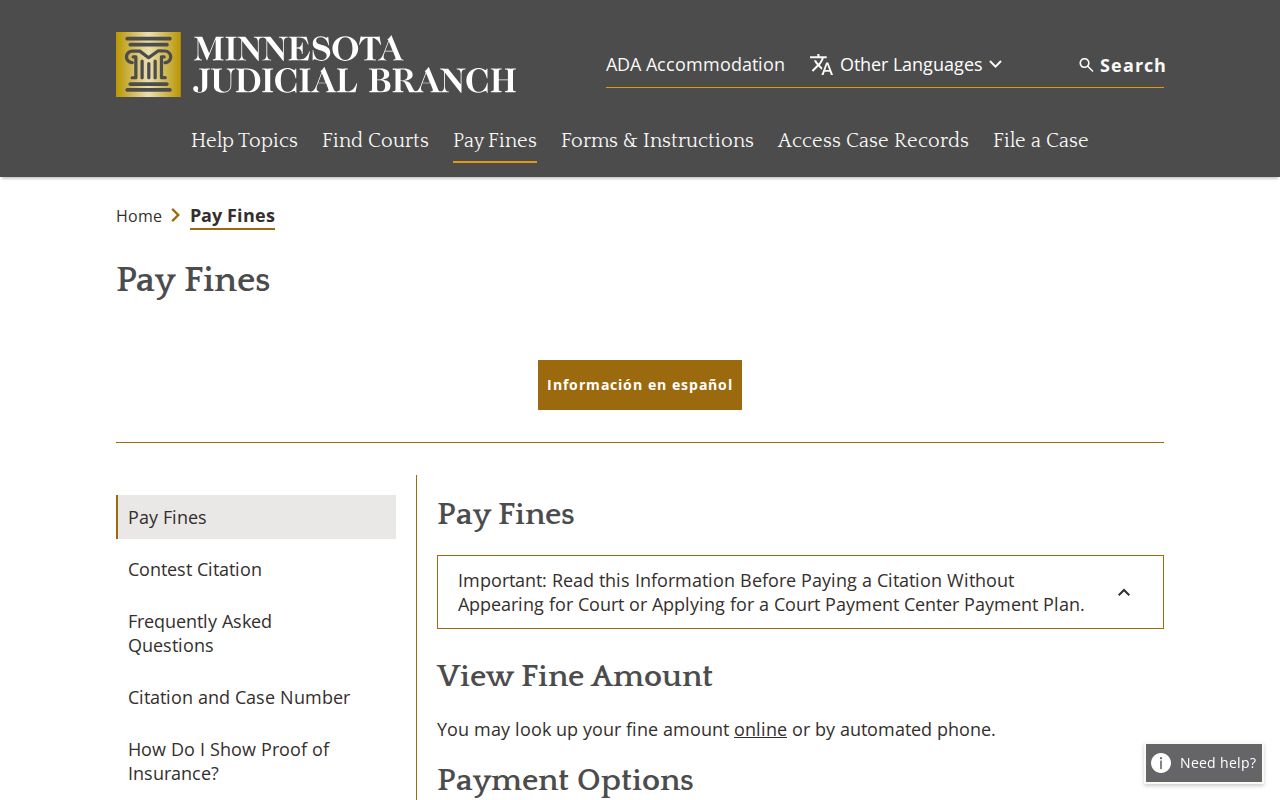
The online payment screen can help you find or pay an eligible citation. It cannot tell you whether a Minnesota traffic warrant is active or already recalled. For that answer, the issuing court remains the source. Note: Minnesota Court Payment Center entry can lag a new citation, so track the ticket’s case number and deadline while you wait.
Paying or Lifting a Traffic Warrant
A Minnesota traffic warrant comes off the record through a court order, never through the citation balance alone. Call the District Court in the county where the case was filed. Ask three things: is the warrant active, can the case simply be paid, and is a hearing or motion required. If the citation is payable and no warrant blocks that route, the Court Payment Center may accept payment or an eligible payment-plan request. Even then, a judge or court administrator must process the court action before the warrant record changes.
- Find the Minnesota court file by citation or case number and identify the filing county.
- Ask Court Administration whether the warrant requires a hearing, recall order, bond, or surrender before payment.
- Follow the court’s instruction for an appearance, eligible citation payment, or payment-plan request.
- Request confirmation that the court entered the needed order and separately check with DPS/DVS if a license notice exists.
Caution: A citation receipt or state surcharge does not prove a Minnesota traffic warrant was recalled; confirm court status, then check any license notice separately.
The court may have to send proof of compliance to DPS, and the license record and warrant record do not update together. Keep your receipts, hearing notices, and filed orders. If the court directs a surrender, ask the Sheriff’s Office or jail about intake and accepted bond methods before you arrive.
Minnesota Citation Surcharges Are Not Warrant Fees
Minnesota’s Court Payment Center lists state surcharges attached to some traffic citations. Those dollars belong to the citation balance. They are not a fee to recall a warrant. The court order and the case decide what must be paid, and local charges vary by venue. The state sets no standard warrant-clearance charge and no statewide traffic-warrant program fee.
| Citation type | State surcharge listed | What it means |
|---|---|---|
| Parking-related offense | $12 | State citation surcharge, not a warrant-lift payment. |
| Select transit offense | $25 | State citation surcharge, not a warrant-lift payment. |
| Other offense | $75 | State citation surcharge, not a warrant-lift payment. |
The Minnesota Judicial Branch cautions that local charges may be added in specific venues, and the checkout amount depends on the citation. Never treat a surcharge figure as a bond amount, a warrant recall fee, or a promise of license clearance. Ask the issuing court what order is needed and read the itemized balance for your case. Note: The $12, $25, and $75 figures are state citation surcharges; paying them does not buy or automatically confirm recall of a Minnesota traffic warrant.
Minnesota Payment Plans Do Not Recall Warrants
An eligible Court Payment Center plan calls for payments of $50 per month until the covered fine and fees are paid off. Not every citation qualifies; eligibility depends on the citation type and where the case stands. The Judicial Branch’s payment-plan request page lists the application fields and the conditions, and the form itself is a request to pay an eligible citation over time rather than a request to recall an active Minnesota traffic warrant. Before you submit a plan request, check whether a warrant already appears in the case or whether the court confirms one is active; if so, contact Court Administration first. Keep in mind that a payment agreement does not prove a judge recalled the warrant or that DPS received proof of compliance.
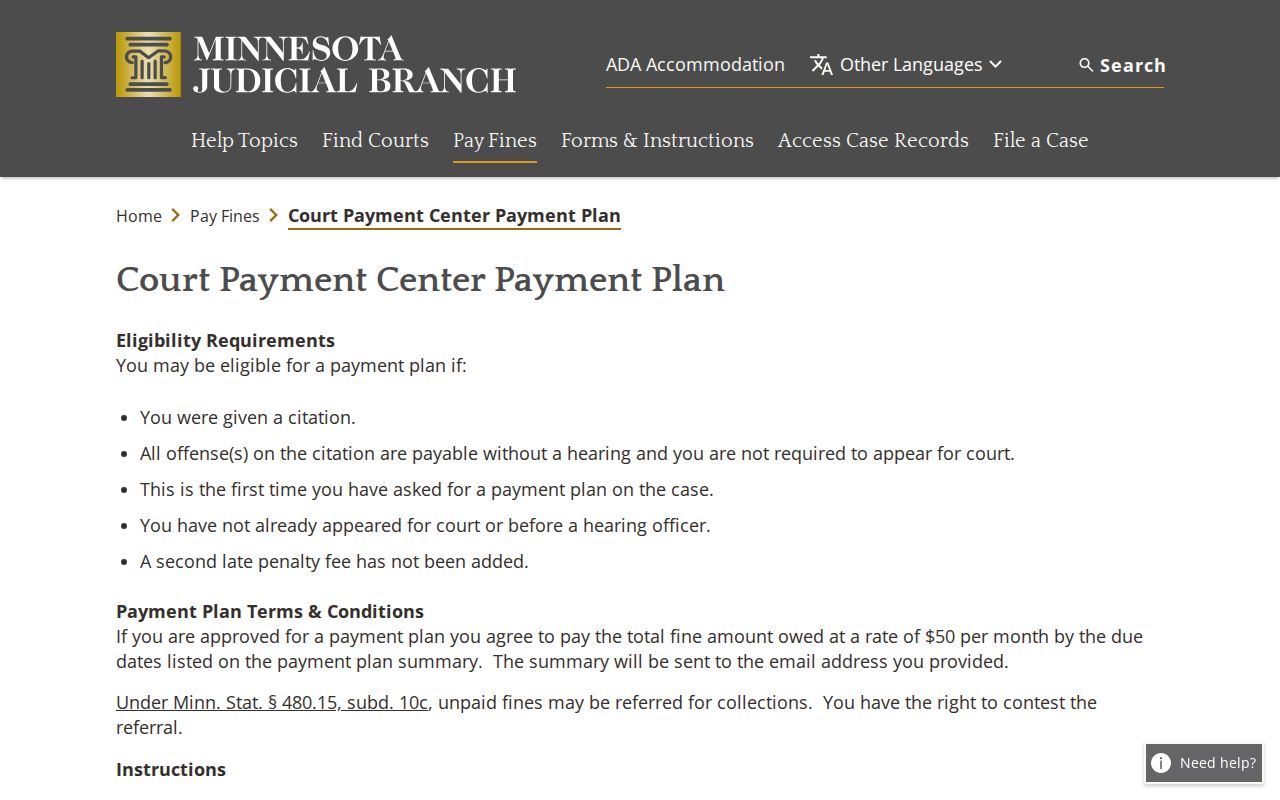
Use the form for the payment request it serves. Ask the issuing Minnesota District Court about the warrant itself.
Traffic Warrant vs Driver Record
A Minnesota traffic warrant is a court order inside a District Court case. DPS/DVS maintains driver-license status under the licensing laws. Those two records answer different questions. The court can say whether its warrant remains active. DPS/DVS can explain a suspension notice and what proof clears it. A suspension does not prove a warrant exists, and clearing a warrant does not rewrite a driver’s licensing history. For warrant status, use the court’s case record in the issuing county. For the license issue, use DPS/DVS. MCRO, the Court Payment Center, and DVS each handle a different task; none replaces the other two.
| Feature | Traffic Warrant | Driver Record |
|---|---|---|
| What it is | A District Court order tied to a traffic case; a judge decides whether process issues. | A licensing status or record kept by Minnesota DPS/DVS. |
| Who maintains it | The District Court in the filing county; the Sheriff’s Office handles execution. | Minnesota Department of Public Safety, Driver and Vehicle Services. |
| How it changes | Court appearance, recall, payment, bond, or another court-directed step, as ordered. | Proof of court compliance must satisfy the Commissioner’s requirements. |
| Where to ask | Issuing Court Administration and Sheriff’s Office. | DPS/DVS using the license notice or status route. |
Minnesota Traffic Warrant and License Status
A traffic notice that suspends a license leaves you with two separate jobs. Handle the court case first. Ask the filing county whether the citation was resolved, what compliance the judge ordered, and whether a warrant is still active. Then follow the notice's instructions for proof of compliance and check with DPS/DVS that the license record has been updated. Under Minnesota Statutes section 171.16, a suspension stays in place until the Commissioner receives satisfactory evidence that the person complied with the court order. The Minnesota Driver and Vehicle Services page is the official licensing route for that second task. The state DVS site offers no public warrant-specific FTA lookup. A license-status result there says nothing about a Minnesota traffic warrant, so the issuing court remains the place to confirm whether one exists.
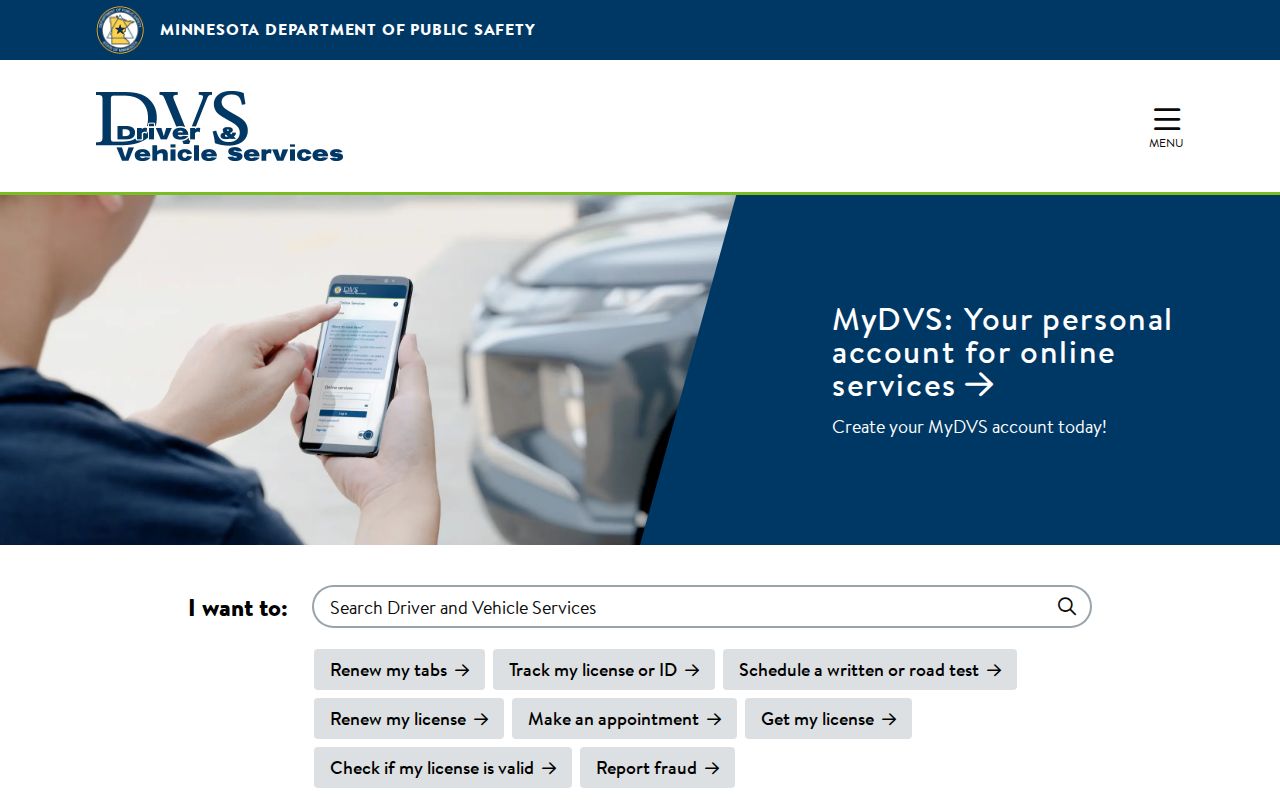
A license hold and an arrest warrant call for different fixes. One lives with DPS, the other with the court. Keep the court's filed order and any DPS notice handy while you check each status separately. Note: A Minnesota DPS/DVS status answer covers the license file only, while the District Court confirms the warrant order.
Minnesota Warrant Resolution Events Stay Local
Minnesota sets up no statewide amnesty week for traffic warrants. Resolution events stay local. A county or court may host one, but it can limit eligible cases and cap how many people it takes on a given date. One local event notice does not create a general statewide way to clear Minnesota traffic warrants. Nor does it promise that every citation or warrant type qualifies. Winona County's official notice lists a warrant-resolution event for November 12, 2026. Read its eligibility, capacity, and terms straight from the notice before you count on it. What that page records is one county's event notice, not a statewide program and not a list of people with warrants. For a specific Minnesota traffic case, the issuing District Court and Sheriff's Office still hold the current warrant status and the next steps.
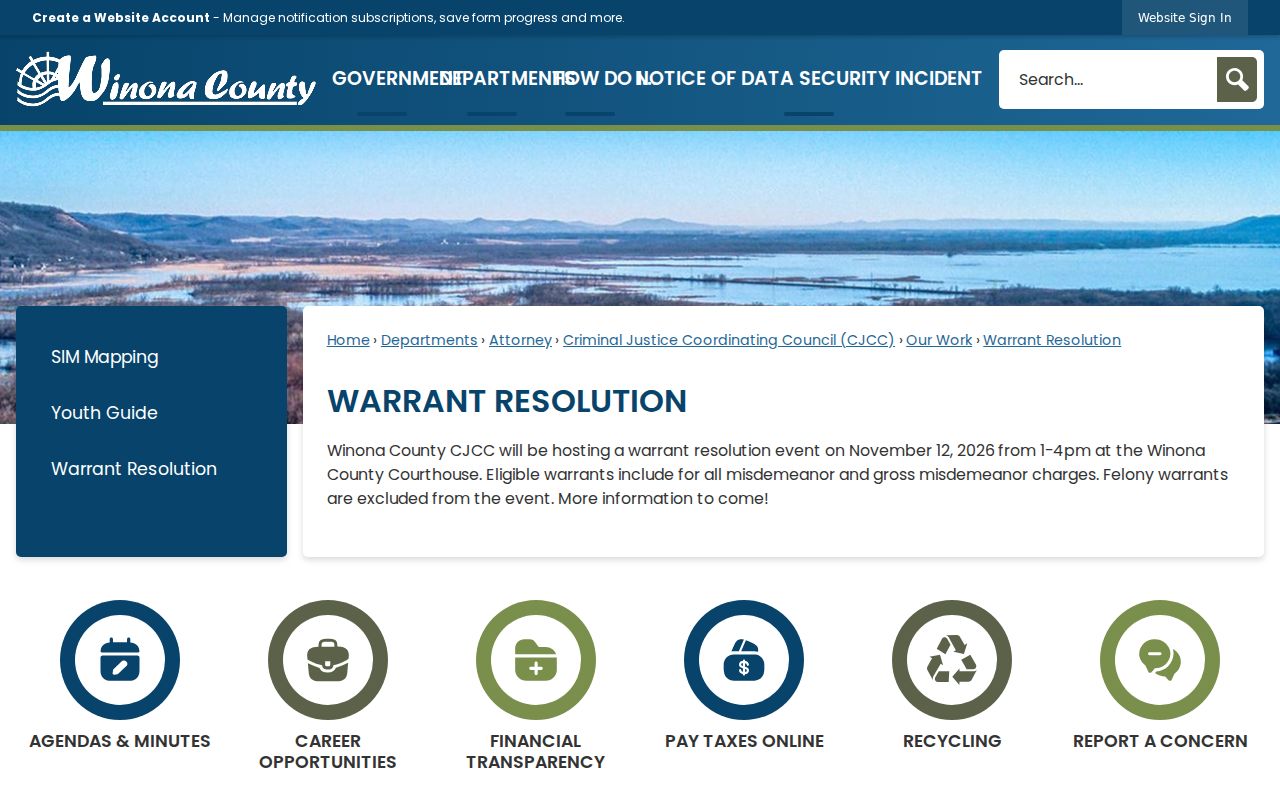
One local example only. For any Minnesota traffic case, the issuing District Court and its Sheriff's Office hold the current warrant status and the next steps.