
Municipal Court Warrants in Minnesota
People search the phrase "Minnesota municipal court warrant" all the time, but Minnesota runs no municipal, city, or justice-of-the-peace court tier. City ordinance and traffic citations get filed and decided in Minnesota District Court. When a warrant comes out of a city-originated case, it belongs to that District Court file in the county venue, and no city court sitting beside the county system issued it. A city police officer, or another authorized officer, may write the citation itself. From there the District Court judge decides whether court process is needed, Court Administration keeps the case record, and the county Sheriff's Office or another officer authorized by law may execute a warrant. So a warrant check comes down to this: find the city case in District Court, then confirm it with the filing county's Court Administration and Sheriff's Office.
Minnesota Has No Municipal Court Warrant Tier
Minnesota's judicial structure has one statewide trial court: District Court. Criminal, traffic, family, juvenile, and city-ordinance matters all use divisions or calendars within that system. A "municipal court warrant search" therefore points to no separate city-court portal. A city may start a case by issuing a citation, but the court record and any warrant stay in the District Court venue for the filing county.
Key point: In Minnesota, a city citation is not a municipal-court case. Search the District Court file and ask that county’s Court Administration about any warrant.
The Minnesota Judicial Branch's District Court overview describes the court system and its county locations. That statewide structure corrects the common out-of-state assumption that a city marshal or municipal clerk holds a separate warrant record.
How Municipal Warrants Differ From County Warrants
Minnesota uses the same District Court system for a city-originated ordinance case and a county-filed criminal case. The venue and case type can differ, but no city court warrant competes with a county court warrant. In each case, a District Court judge issues process, County Court Administration keeps the file, and authorized law-enforcement officers execute it. A city citation may come from local police, while a county-filed case may begin with a sheriff or prosecutor. Those are different entry points into Minnesota's court system, not different court tiers. For missed appearances, the companion Minnesota bench-warrant information explains how an existing case can lead to a bench warrant.
| Feature | City-Originated Case | County-Filed Case |
|---|---|---|
| Question | City-originated citation case | County-filed District Court case |
| Issuing court | Minnesota District Court in the filing county | Minnesota District Court in the filing county |
| Case source | City ordinance or traffic citation may be issued by city police | Criminal complaint or other case filed in District Court |
| Where record sits | District Court case file and MCRO when public access allows | District Court case file and MCRO when public access allows |
| Who may serve it | Sheriff, city police, or another officer authorized by law | Sheriff, city police, or another officer authorized by law |
Note: Minnesota separates these cases by where they began, not by a city-versus-county court structure.
Minnesota City Citation Warrant Path
A city-originated citation does not create a municipal-court file in Minnesota. The case is routed to District Court, where its court file may be found by citation number, court file number, or a county search in MCRO. The issuing officer and the court custodian differ: city police may issue the ticket, while District Court handles hearings, payment orders, and any warrant action. That split can matter after a missed date. Do not look for a city marshal's warrant list, and do not assume a county sheriff search has every case. Court Administration in the filing county can connect a citation to the correct District Court file and say whether an order has issued. The county Sheriff's Office can then explain execution, surrender, or bond steps if a warrant is confirmed.
How to Check a Municipal Court Warrant
For a Minnesota municipal-court warrant search, start with the citation or District Court file, not a city-court portal. MCRO offers a Citation Number tab and a county or court-location selector. If the case does not appear by name, search with the ticket number or call Court Administration in the county that filed it. The public case view may be limited, and a missing result is not proof that no warrant exists.
- Read the citation or notice for the city, citation number, and response date.
- Search MCRO by citation number or court file number, then open the case’s Warrants section and Register of Actions.
- Use the Minnesota county directory to identify the filing county and reach its Court Administration.
- Ask the court whether a judge issued an active warrant and what hearing, motion, or appearance is required.
- If the court confirms a warrant, contact the county Sheriff’s Office or jail for service and surrender instructions.
The Sheriff's Office and Court Administration answer different questions. The court maintains the case and can explain court action. The sheriff or jail can confirm operational status plus local booking or bond logistics.
Minnesota MCRO Municipal Warrant Search
Start a Minnesota municipal warrant search at Minnesota Court Records Online. The portal searches District Court cases. Tabs cover Name, Case Number, Citation Number, and Attorney, and a location selector can run statewide or narrow to one county. Holding a paper city citation? The citation-number tab often leads straight from the ticket to the court file. Minnesota has no municipal court tier, so the form opens no separate city database. The blank search form displays no result row and no personal details. Remote name searches may be restricted for pending criminal, traffic, or petty-misdemeanor matters. A blank return does not prove no warrant exists. Try the court file number, or call the filing county's Court Administration. MCRO is a case search, not a complete statewide warrant list.
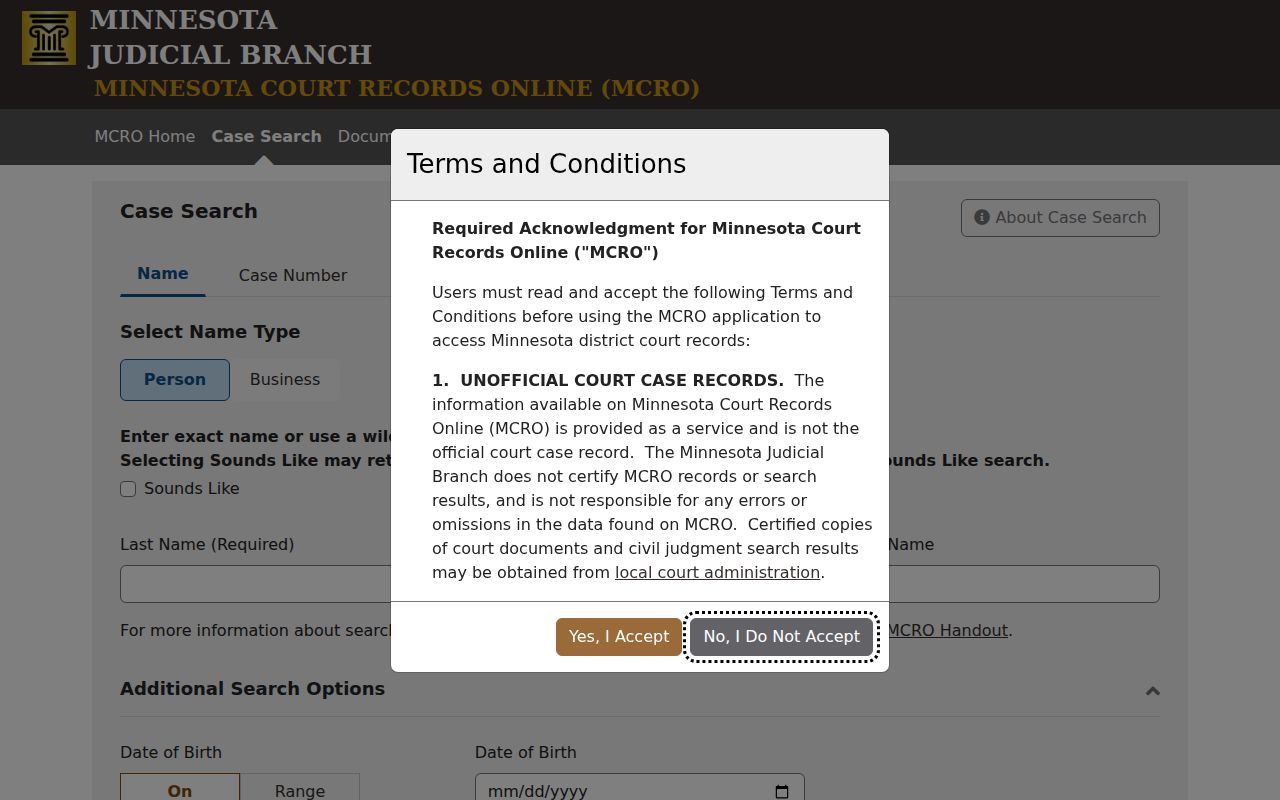
Once a case opens, read the Register of Actions and Warrants section, then confirm any active order with the county court. Note: MCRO is public case access, not a complete Minnesota warrant list, and service status there may not be current.
What a Municipal Court Warrant Shows
Minnesota has no municipal court file of its own. A city case lives in the District Court case view, and that is where a municipal warrant question gets answered. The Judicial Branch's MCRO case-details handout walks through the sections you will meet: case, party, charge, hearing, bond, warrant, and judgment. What appears depends on the case and on what is public. So a "municipal court warrant" search is really a hunt for a city-originated District Court case, not a separate city-issued warrant format.
| Warrant number | No public statewide warrant-number format was confirmed. A District Court file number identifies the case, not necessarily a unique warrant. |
|---|---|
| Party information | MCRO may show party details when remote access rules allow. No real subject values belong in an example. |
| Citation or offense | The city citation number and ordinance or traffic charge may appear in the case record. |
| Issuing court | Minnesota District Court in the filing county, not an independent city court. |
| Bond and hearings | Bond details and court events may appear where available; the order controls what is due or scheduled. |
| Warrants section | A warrant flag or event may appear in the case view. It is not a complete warrant row schema or a guarantee of current service status. |
The handout documents field types, not a separate municipal warrant-number format, public agency field, or universal status code. An online case flag is never the final word. Confirm the specific order with the issuing county's Court Administration and Sheriff's Office. That call settles the question.
Minnesota City Cases and Bench Warrants
Miss a court date in a city-originated case, and the consequences land in District Court. A bench warrant can issue when the governing rule and the case order allow it. Minnesota Rule of Criminal Procedure 3.01 covers what happens when a defendant fails to appear after a summons. It is not an automatic result of every unpaid ticket. The District Court judge acts within the pending case, and the warrant stays in that case file. Sign-and-release applies only in narrow circumstances. It is no general amnesty or recall path. If a Minnesota city citation may have produced a warrant, use the citation number to find the District Court case. Ask Court Administration whether a judge must act. Ask whether the case is payable or needs a hearing, and whether counsel, bond, or a court-directed surrender step is expected. This is a bench-warrant question, not a visit to a municipal clerk. See Minnesota bench warrants for the missed-court process.
Resolving a Municipal Court Warrant
Fixing a Minnesota "municipal court warrant" means working the District Court case that grew from the city citation. The right step depends on the order. The court may want a hearing, a motion to recall, an appearance with counsel, payment on an eligible citation, bond, or surrender. The city that wrote the ticket cannot recall a District Court warrant. That power sits with the court. Find the filing county in the Minnesota county directory and call its Court Administration.
- Ask Court Administration to confirm the case, warrant status, and the next court date or required motion.
- Ask whether a lawyer should appear, whether a hearing can be scheduled, and whether payment is allowed before that hearing.
- If the court directs surrender, call the county Sheriff’s Office or jail for current intake and bond instructions.
- After the judge acts, obtain the filed order or receipt and verify that court and law-enforcement status changed.
Caution: Do not assume a city citation was cleared by payment alone; ask the Minnesota District Court whether a separate warrant order remains active.
Minnesota sets no statewide general warrant-recall form or fee. Court staff can explain the filing steps. They cannot promise that a judge will recall an order by phone. Keep written notices and proof of compliance. A scheduled date is not a recall until the court enters that order. Note: a Minnesota warrant remains a court matter until the issuing District Court enters the appropriate order and the status is confirmed.
Minnesota Municipal Warrant Terms for City Cases
A few terms sort the city citation from the court action that follows. Minnesota court records use District Court case categories and events. No separate city-court warrant tier appears anywhere in them. When calling about a city-originated case, use the case number and the court's own wording.
- Municipal-court warrant
- A search phrase for a warrant tied to a city citation. In Minnesota, the case and warrant belong to District Court.
- Bench warrant
- A judge’s order in an existing case, often after a missed appearance or failure to comply with an order.
- Court Administration
- The county District Court office that keeps the case file and can explain court status and next steps.
- MCRO warrant flag
- A case or party indicator in Minnesota Court Records Online. Read the case-specific Warrants section and confirm the current order.
- Capias
- Minnesota court materials do not identify capias or capias pro fine as a statewide warrant term; there is no separate city-court process under that name.
Check any term against the actual order and case. A search label is not the last word. For a confirmed Minnesota warrant, the issuing county's Court Administration and Sheriff's Office provide the practical status path.
Minnesota Municipal Warrant Resolution Notices
Minnesota runs no statewide annual warrant-amnesty week. Resolution events are local. Each notice sets its own date, capacity, eligibility, and case types. One event existing does not make every city-originated citation or municipal-search result eligible. Read the current terms. Ask the issuing District Court whether the event covers your case. Winona County's official warrant-resolution notice lists an event scheduled for November 12, 2026. Reconfirm those terms before relying on the listing. The notice gives time and place only. It is not a warrant roster and not a statewide municipal-court program.
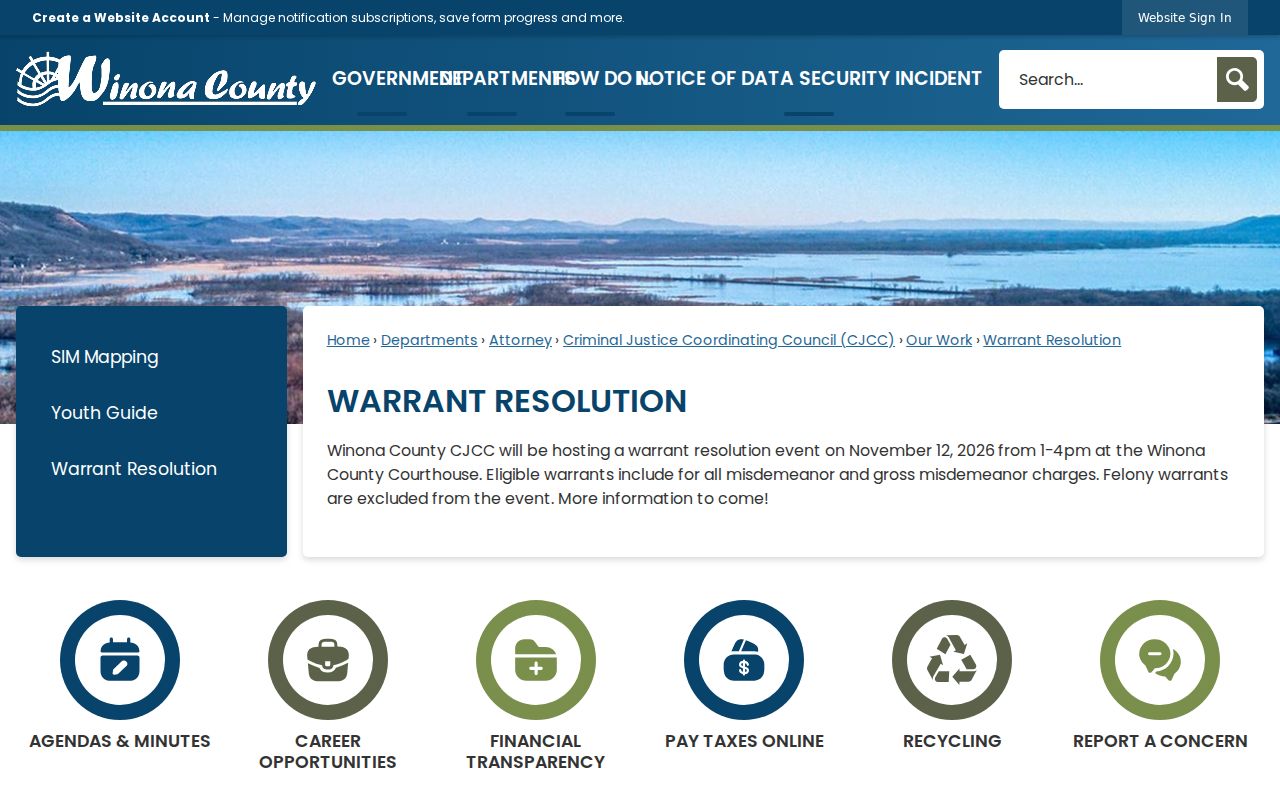
This local example does not prove a specific Minnesota city citation is eligible. Confirm your case directly with the filing county's Court Administration.