
Bench Warrants in Minnesota
A Minnesota bench warrant grows out of a case already in court, not from a brand-new complaint. The usual triggers are a missed criminal or traffic hearing, a broken release condition, or contempt in a family or child-support matter. Failing to appear is the classic one. The judge signs the order. The case file keeps it. That is also why it is not a new charge; the District Court holding the case decides whether to recall the warrant or set another step. Minnesota handles traffic cases in the same court. An unpaid ticket alone does not mean a bench warrant issued. Under Minnesota Statutes section 169.92 and section 171.16, a traffic failure to appear can be reported to the Department of Public Safety in specified cases. That reporting is a licensing process, separate from any warrant. Those are three different questions: the court record, the license action, and whether the warrant was served.
Minnesota Bench Warrants Stay in District Court
One trial court handles everything in Minnesota: District Court. Criminal, traffic, family, juvenile, and city-ordinance cases all land there. A bench warrant stays in the file of the case that produced it. Court Administration keeps the record. The Sheriff's Office or another authorized officer executes the order. Minnesota runs 10 judicial districts across 87 county venues, and there is no separate municipal or justice-of-the-peace system where an independent bench warrant could sit.
| Minnesota court area | Relevant matters | Warrant and record role |
|---|---|---|
| District Court, criminal and traffic | Felony, gross-misdemeanor, misdemeanor, petty-misdemeanor, traffic, and city-ordinance cases. | A District Court judge issues process; Court Administration keeps the county case file. |
| District Court, family | Family and child-support proceedings, including contempt. | A District Court judge issues any arrest warrant; a child-support magistrate may recommend action after an FTA. |
| District Court, juvenile | Juvenile delinquency and protection matters. | A judge issues process; public access is limited by law and court rules. |
| Appellate courts | Review of District Court decisions. | The Court of Appeals and Supreme Court are not routine trial-level warrant desks. |
The Minnesota Judicial Branch court structure page lays out the court levels. Confirmation still happens county by county. Start where the case was filed.
Note: These statewide Minnesota court counts describe structure only; they do not estimate how many bench warrants are open.
How a Bench Warrant Is Issued
Minnesota Rule of Criminal Procedure 3.01 governs summonses and arrest warrants in criminal cases. It sets when a summons is preferred and when a warrant is required. A judge reads the complaint for probable cause. That review asks for facts supporting two things: an offense occurred and this defendant committed it. The rule leans toward a summons. A warrant needs one of the stated conditions. If the defendant ignores a summons, a warrant must ordinarily issue, though eligible cases can follow a narrow sign-and-release path that sets a new date without authorizing arrest. The order attaches to the pending case, and the issuing judge or court controls the next judicial step. Child-support contempt works differently in Minnesota. Under Minnesota Rule of General Practice 374.04, a child-support magistrate, the court official who handles support matters, certifies a failure to appear and recommends that a warrant issue. The magistrate does not issue it. A District Court judge makes that decision. Even a citation written by city police stays inside the District Court structure, so read the Minnesota criminal rule and the filed order for the matter at hand.
Note: A Minnesota bench warrant belongs to the existing case; the complaint and court order control the next step.
Minnesota Missed Dates and Bench Warrants
A missed court date can bring a bench warrant, but Minnesota procedure turns on the case, the notice, and the court's order. Rule 3.01 covers a criminal defendant who skips a summons. One narrow path softens the first miss. An eligible first missed initial appearance can go through sign-and-release, which sets a new date without authorizing arrest. That is not amnesty. Minnesota promises nothing for every missed date. Traffic matters need their own care. Minnesota law allows failure-to-appear reporting to the Department of Public Safety in specified circumstances. That license process is not a bench warrant. An unpaid payable citation in Minnesota does not by itself prove a warrant issued. Check the case record first, then call the issuing District Court if anything is unclear.
Note: A Minnesota traffic notice, license status, and court warrant are separate records; ask the issuing court which action applies to the specific case.
Bench vs Arrest Warrant
Minnesota uses both tools, but for different moments. A bench warrant answers an obligation inside a pending case, most often a failure to appear. An arrest warrant follows a complaint and a judge's probable-cause review. Both are court orders. The sheriff or another authorized officer executes either one. The case file and its order then control how a person can next appear or seek release in Minnesota.
| Feature | Bench Warrant | Arrest Warrant |
|---|---|---|
| Trigger | Failure to appear or comply in a pending court matter. | Complaint and supporting material establish probable cause for an offense. |
| Who issues it | A District Court judge in the pending case. | A judge after reviewing the complaint and supporting material. |
| Underlying record | An existing case with a missed appearance or court obligation. | A criminal complaint and the resulting case process. |
| Next step | Ask the issuing court about an appearance, recall request, or bond condition. | Confirm the warrant, counsel, surrender, and bond instructions with the issuing county. |
Neither label settles current status or guarantees release. For the other record type, see Minnesota arrest warrants.
No Minnesota Municipal Bench-Warrant Tier
Minnesota runs its court system differently from many states. There is no separate municipal, city, or justice-of-the-peace trial court here. A city officer may write the ordinance citation, but the case is filed and heard in District Court. So no Minnesota municipal-court bench-warrant portal exists, and there is no city-court clerk to call. The state's vocabulary also has no separate capias pro fine tier for bench warrants. What matters is the citation number or District Court file number. Plug that into Minnesota MCRO search, which offers a citation-number tab and a county location selector. Then contact the county Criminal or Traffic Court Administration office. Remember that the sheriff is not the issuing court. Court Administration confirms the case record and explains what the judge requires. The county Sheriff's Office or jail handles execution, surrender, and bond logistics instead. A city police department may route a person to the filing court, but it cannot replace that court's status confirmation. A city-originated case remains a District Court case throughout the Minnesota search.
How to Resolve a Minnesota Bench Warrant
Resolution starts with the Minnesota District Court case that issued the bench warrant. Call that court first. The judge decides whether the next step is a hearing, a motion, a new date, or an appearance in person. A lawyer can advise on proper procedure and coordinate with the prosecutor. Still, contacting counsel or requesting a date does not by itself make the warrant inactive. Use the county directory to identify the issuing court and sheriff before arranging any surrender or payment in Minnesota.
- Find the case by citation or court file number in MCRO, or call the county Court Administration. Ask whether the warrant is active and which case obligation triggered it.
- Ask whether a judge must act, whether the court can set a hearing, and whether a motion to recall is accepted. Research found no general statewide recall form or fee schedule.
- Discuss the options with an attorney, especially if the missed hearing involved a criminal charge, probation, or family contempt.
- If the court directs an appearance or surrender, ask about the exact location, intake process, identification, bond type, payment method, and required timing.
- Attend the hearing or complete the court-ordered step. Then request a filed order or updated case status and confirm with the Sheriff’s Office that local warrant status is updated.
Caution: Do not assume a Minnesota bench warrant has expired or cleared online; ask the issuing court to verify status before choosing how to appear.
Minnesota Sign-and-Release Gives a New Date
Minnesota sign-and-release is a narrow fix, not a general bench-warrant recall. It applies only to an eligible missed initial appearance. Under Minnesota Statutes section 629.415 and the criminal rules, the person gets a new court date. The warrant issued this way expressly does not authorize arrest. Eligibility depends on conditions, including the type and timing of the missed appearance. Do not treat it as a promise that an existing warrant was cancelled. Only the court's direction controls the case. The Judicial Branch's CRM1401 form information sets out the limited law-enforcement use and the new court-date purpose. It is not a public self-service recall application. It is not a general motion to recall a bench warrant either. Ask Court Administration whether the process fits the specific Minnesota case, then follow the returned date and any other order.
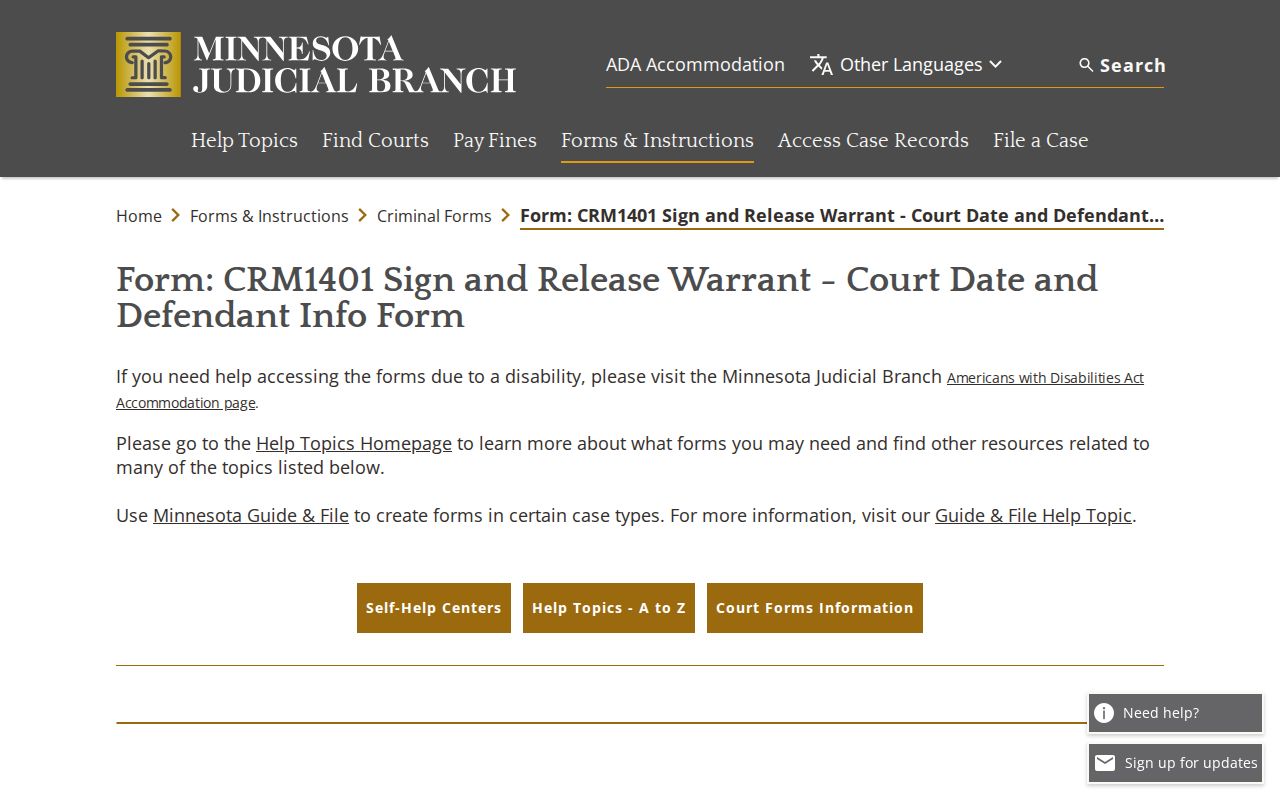
Law enforcement uses the form for one eligible process. It is not a general motion to recall a bench warrant. Note: CRM1401 is not a general Minnesota motion to recall a warrant, so confirm status with Court Administration.
Which Court Issued It
A Minnesota bench warrant belongs to the District Court judge and case that issued it. That court controls recall. Court Administration keeps the file and can explain whether the matter is criminal, traffic, family, juvenile, or another District Court case. The Sheriff's Office may serve the warrant. It does not decide whether to recall it. A county name on a ticket or case notice helps identify the right court location. Use the Minnesota county directory to find the county court and Sheriff's Office. For a city-originated citation, use MCRO's citation or court-file number and contact that county's District Court. No separate municipal or JP court route exists in Minnesota. If the case involves child-support contempt, ask for the Family Court or child-support calendar. For a public record not available remotely, ask the court about courthouse access. One more limit matters: Minnesota has no complete public bench-warrant roster. The Bureau of Criminal Apprehension (BCA) connects warrant data to the restricted criminal-justice data communications network (CJDN) under section 299C.115, not a public lookup.
Minnesota Bench-Warrant Appearance Questions
If a Minnesota bench warrant may be tied to a missed date, the next useful step is a private status call to the issuing court. Have the case number or citation handy. Ask whether the warrant remains active. Ask whether the record sits in a criminal or family file, whether a judge must act, and whether a hearing can be scheduled. Court staff explain procedure and the next event. They do not give legal advice or predict a judge's ruling. Before going to a jail or courthouse, ask about bond or release terms. If surrender is required, the county Sheriff's Office or jail can explain the local intake point, accepted payment type, and current process. After a hearing, keep any written order. Then check that both the court record and law-enforcement status reflect the judge's decision. A paid fine, scheduled hearing, or attorney request alone does not confirm a recall in Minnesota. The Minnesota Judicial Branch county court selector routes to the filing county. Use it with the county directory to reach the office responsible for the case. For agency-held public data, a focused Minnesota Government Data Practices Act request may ask for existing records, subject to confidentiality review under section 13.82. It cannot substitute for Court Administration's case-status confirmation.
- Bench warrant
- A judge’s order in an existing case, often after a missed appearance or failure to comply.
- Recall
- A court action that withdraws or cancels a warrant.
- Quash
- A court action that sets aside a warrant or order.
- Bond
- Money or another security condition set by the court to support a required appearance.